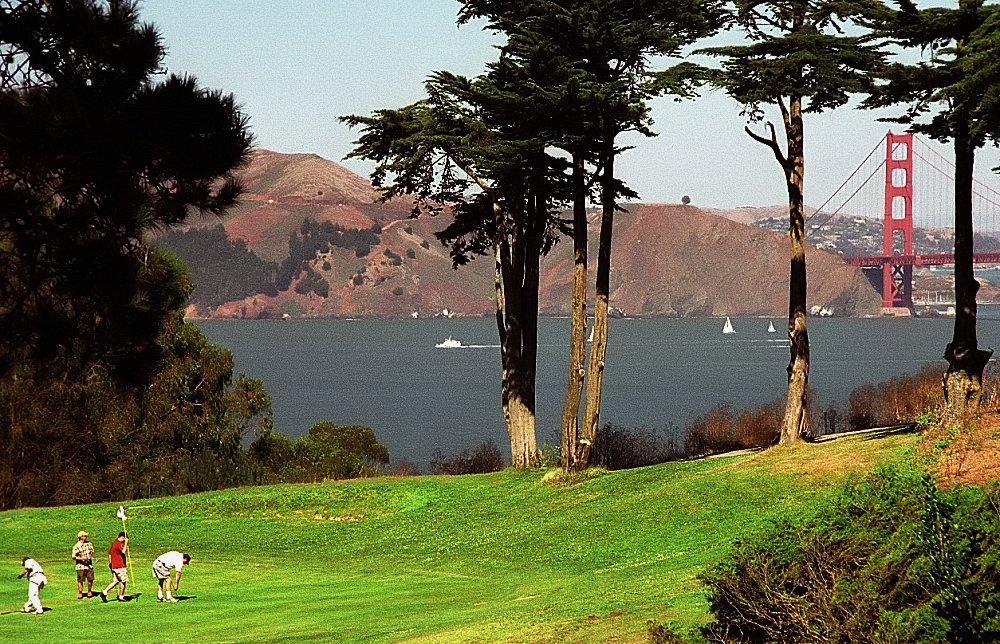
There was a stretch in the middle of the twentieth century when the most important golf city in America was not Augusta, not Pinehurst, not even New York. It was San Francisco. Golf writers who grew up there still call it "the city game" — the muni-bred, match-play culture that once made San Francisco the center of the golf universe.
That claim sounds extravagant until you run the numbers. Out of the Bay Area's public courses and caddie yards — Harding Park, Lincoln Park, and their neighbors ringed around Lake Merced and Land's End — came a generation of players who, between them, won each of golf's four modern major championships: the U.S. Open, the Open Championship, the PGA Championship, and the Masters. The city's adopted amateur star added back-to-back U.S. Amateurs. And when that generation put down its clubs, it picked up microphones: for a stretch in the 1990s, the lead golf voices on CBS, NBC, and ABC all belonged to San Franciscans.
This is the story of how a windblown city at the edge of the continent built that golf culture — course by course, muni by muni — and of the people who made it matter.
The First Fairways in the West (1895–1918)
Golf arrived in San Francisco almost as soon as it arrived in America. In the mid-1890s, the first nine holes were laid out on the Presidio military reservation — the Presidio's own histories date the course variously to 1895 and 1896. That layout grew into today's Presidio Golf Course, one of the oldest courses in the American West, and a place where Theodore Roosevelt reviewed troops on the links in 1903. For roughly its first century it was reserved for the military and the private Presidio Golf Club; public play arrived only in the 1990s, after the army post became a national park.
The private clubs organized just as quickly. The San Francisco Golf Club was founded in 1895, making it one of the oldest clubs in the American West. It played its earliest golf at the Presidio, moved to the Ingleside district at 19th and Ocean in 1904, and settled at its present site near Lake Merced in 1915, where A.W. Tillinghast laid out the masterpiece — unveiled in 1918 — that still ranks among the finest courses in the world, and remains one of the most private.
The city itself got into the game early too. In 1902, a rudimentary three-hole course appeared on the bluffs above Land's End at Lincoln Park, with the Golden Gate below and, eventually, a bridge in the view. It grew to a full eighteen holes over the following two decades, shaped over the years by Jack Neville (of Pebble Beach fame), Herbert Fowler, and Jack Fleming. Lincoln Park would become the most consequential 5,100 yards in American public golf — more major champions learned the game on its tiny greens than on courses ten times as celebrated.
Then, in 1918, the Olympic Club — the country's oldest athletic club — assumed operations of the financially struggling Lakeside Golf Club on the city's southwestern edge. By 1922 it had bought enough surrounding land for two courses, and in 1924 Willie Watson and Sam Whiting completed the original Lake and Ocean courses. The Lake Course would go on to host U.S. Opens famous for breaking the hearts of the greatest players who ever lived. More on that below.
Harding Park and the Municipal Golden Age
San Francisco's city fathers watched all this and decided the public deserved a championship course of its own. On July 18, 1925, Harding Park opened on 163 acres along Lake Merced, designed by the same Watson–Whiting team that had just built the Olympic Club's courses next door. A muni with major-championship bones, from birth.
The city already had a championship to play on it. The San Francisco City Championship — "The City" to everyone who has ever entered it — was inaugurated in 1916 with the opening of Lincoln Park (some histories date it to 1917), and it has been played every year since; its organizers bill it as golf's oldest consecutively played championship. Hundreds of players still enter every year. It began at Lincoln Park, later made Harding Park its home, and its list of champions reads like a hall of fame roster: Ken Venturi, George Archer, Juli Inkster.
The man who kept these courses alive deserves his own chapter in this history. Jack Fleming, born in County Galway, Ireland in 1896, came to California as Alister MacKenzie's construction foreman, working on Cypress Point, Pasatiempo, and the Meadow Club. In 1930, Golden Gate Park superintendent John McLaren commissioned MacKenzie to build the city's third municipal course on coastal land at Sharp Park in Pacifica — a genuine seaside links, built by the architect of Augusta National, that opened in 1932 and remains one of the only places on earth where the public can play a MacKenzie original for a muni green fee. When the course was finished, Fleming stayed, joining San Francisco's parks department as superintendent of its municipal courses — a job he held for some three decades while designing dozens of Northern California courses himself after the war. The nine-hole Fleming Course at Harding Park carries his name.
This was the infrastructure — Harding, Lincoln, Sharp Park, the Presidio, with Olympic and the San Francisco Golf Club behind their hedges — on which the golden age was built.
The City Game: When San Francisco Ruled Golf
The peak came in the 1950s, and its emblem was a municipal tournament final. In 1956, the City Championship's match-play final pitted Ken Venturi against Harvie Ward — at that moment, arguably the two best amateur golfers on the planet. Ward was the reigning U.S. Amateur champion; within a month, Venturi would come within a final-round collapse of winning the Masters. An estimated 10,000 spectators walked Harding Park to watch them, and Venturi's win was heralded in bold type atop the front page of the San Francisco Chronicle. By Venturi's own later telling, he greeted Ward on the first tee with a vow: Ward had stolen his city, and he had come to take it back.
That same year came the round immortalized in Mark Frost's book The Match: a private four-ball at Cypress Point, born of a wager between car dealer Eddie Lowery (Ward and Venturi's employer and patron) and businessman George Coleman, pitting the two San Francisco amateurs against Ben Hogan and Byron Nelson. The professionals won it, 1 up — and by most retellings they needed a best-ball somewhere in the 57–58 range to do it.
Consider what that scene produced:
Ken Venturi, born in San Francisco on May 15, 1931, learned the game at Harding Park and the city's other public courses. After the near-miss at the 1956 Masters, he turned pro and won the 1964 U.S. Open at Congressional, staggering through 36 final-day holes in near-100-degree heat in one of the sport's most dramatic victories.
Harvie Ward, a North Carolinian who adopted San Francisco (and vice versa) while working at Lowery's dealership, won the 1952 British Amateur and back-to-back U.S. Amateurs in 1955 and 1956 — the best amateur golfer of his era, sharpened in the City Championship.
Bob Rosburg, born in San Francisco on October 21, 1926, and developed at Lincoln Park before starring at Stanford, won the 1959 PGA Championship by a single stroke.
Tony Lema, born across the bay in Oakland on February 25, 1934, learned golf at the Lake Chabot muni, served as a Marine in Korea, and became "Champagne Tony" in 1962 when he promised the press bubbly if he won the next day's playoff — and delivered. He won 11 times on the PGA Tour and took the 1964 Open Championship at St Andrews by five shots over Jack Nicklaus, having played only nine practice holes on the Old Course. He died at 32 in a 1966 plane crash, one of golf's great losses.
George Archer, born in San Francisco and raised in San Mateo, started as a caddie at Peninsula Golf & Country Club and putted for hours on Lincoln Park's practice green — which is now dedicated to his memory. The 6-foot-5½ "Golfing Cowboy" won his first PGA Tour title at the 1965 Lucky International, played at Harding Park, and won the 1969 Masters by one stroke.
Count the trophies: U.S. Open (Venturi), Open Championship (Lema), PGA Championship (Rosburg), Masters (Archer), and the amateur game's two biggest prizes (Ward). One metropolitan area's golf ecosystem, one generation, a career Grand Slam between them.
And the pipeline didn't stop. Johnny Miller, born in San Francisco on April 29, 1947, grew up hitting balls into a canvas tarp in his basement, sharpened his game at Lincoln Park, and joined the Olympic Club's junior program in 1963. As a 19-year-old BYU freshman he qualified for the 1966 U.S. Open at Olympic — his home course — and finished tied for eighth as low amateur. Seven years later at Oakmont he shot the most famous single round in golf history: a final-round 63 to win the 1973 U.S. Open, then the lowest round ever recorded in a major. He added the 1976 Open Championship at Royal Birkdale by six strokes.
The Bay Area's championship lineage runs right into the present through Juli Inkster, born in Santa Cruz on June 24, 1960 and a two-time City champion, who won seven major titles — including U.S. Women's Opens in 1999 and 2002 — and entered the World Golf Hall of Fame in 2000. She remains the only player in LPGA Tour history to win multiple majors in each of three consecutive decades.
Olympic Club: Where Legends Go to Lose
While the munis were producing champions, the Olympic Club's Lake Course was earning a darker reputation: the place where the greatest players of all time came to be beaten by underdogs.
In 1955, the club hosted its first U.S. Open. Ben Hogan had seemingly wrapped up a record fifth Open title when Jack Fleck — an unknown municipal-course pro from Iowa — birdied two of the last four holes to force an 18-hole playoff, then won it. It is still ranked among the greatest upsets in the history of sport.
In 1966, it happened again. Arnold Palmer led Billy Casper by seven shots with nine holes to play. Casper erased all seven, forced a playoff, and beat Palmer the next day. Olympic has since hosted more U.S. Opens — and its pattern of punishing the favorite has never really broken.
The Voices: San Francisco's Broadcast Dynasty
Here is the part of this history nobody else can claim. When San Francisco's golden generation stopped winning championships, it started describing them. From Ken Venturi's arrival at CBS in the late 1960s to Johnny Miller's retirement from NBC in 2019, there was almost always a San Francisco voice narrating golf on American television — and for a stretch in the 1990s, the lead golf analysts on all three networks were San Franciscans.
Ken Venturi joined CBS after retiring in 1967 and stayed 35 years, the longest lead-analyst tenure in sports broadcasting history, until 2002. Johnny Miller became NBC's lead golf analyst in 1990 and held the chair for 29 years, redefining candor in the booth until his retirement in 2019. Bob Rosburg essentially invented the modern on-course reporter at ABC, roving the fairways and delivering his catchphrase — "He's got no chance" — usually moments before the player in question pulled off a miracle.
Print had its San Franciscan too. Art Spander, a Bay Area sports columnist who joined the San Francisco Examiner as a full-time columnist in 1979, had covered nearly 120 major championships by 2009, when the PGA of America gave him its Lifetime Achievement Award in Journalism. He is the only writer to win Golf Writers Association of America first-place awards in five different decades.
Four majors won, then narrated. No other city's golf scene has an export record like it.
Decline and Rebirth: Saving Harding Park
By the 1990s, the municipal system that built all of this had decayed badly. Harding Park's humiliation bottomed out in 1998, when the course that once hosted PGA Tour events was used as a parking lot for the U.S. Open being played next door at Olympic.
The rescue came from Sandy Tatum — Stanford's 1942 NCAA individual champion, a Rhodes Scholar, a San Francisco lawyer, and USGA president from 1978 to 1980. Tatum spent years campaigning to restore Harding to championship condition, assembling city hall, Charles Schwab, and the PGA Tour behind a renovation that reopened the course on August 22, 2003.
The bet paid off almost immediately. Harding Park hosted the 2005 WGC–American Express Championship, won by Tiger Woods in a playoff; the 2009 Presidents Cup; and finally, in 2020, a major of its own — the PGA Championship, won by another young Californian, Collin Morikawa. Tatum, who died in 2017 at 96, didn't live to see it, but he is there in bronze: a Zenos Frudakis statue of Tatum with two First Tee kids was installed outside the clubhouse in 2020, honoring both the restoration and The First Tee of San Francisco chapter he championed at Harding. The course celebrated its centennial in 2025.
Playing the History Today
Almost every chapter of this story is still open for public play. You can walk the Presidio's nineteenth-century corridors under the eucalyptus, putt the same tiny Lincoln Park greens where Miller, Rosburg, and Archer learned, play a true MacKenzie links at Sharp Park for a muni rate, and tee it up at TPC Harding Park on the exact ground where 10,000 people watched Venturi take his City back — and where Morikawa won a major. The San Francisco City Championship is still played every year, more than a century on, and it's open to anyone with a handicap and the nerve.
The deeper stories — Sandy Tatum's crusade, Venturi's road from Harding to Congressional, Ward's amateur reign, Champagne Tony, Rosburg's two careers, Archer's Masters, and the strange fact that one foggy city supplied golf's television soundtrack for a generation — each deserves its own telling, and we've written them. Start with the most influential figures in Bay Area golf.
San Francisco was the center of the golf universe once. Play the munis on a clear morning, with the fog burning off Lake Merced, and it's not hard to believe it could be again.